
It has been just over 10 years since a new type of student program was introduced into the Senior School, in response to demand from universities and colleges for a more skills-based approach to better support students in the post-university environment and in their future lives. In 2015, the College Board — which runs Advanced Placement — launched the AP Capstone program, with St. Michaels University School being one of the first Canadian schools on board. Ten years later, it is time to take stock and see how successful the program has become, not just here at SMUS, but also worldwide.
Denise Lamarche, Director of Academics, said building the program was essential to providing students with opportunities to pursue interdisciplinary research in areas of particular interest to them. The program was supported by a keen team of teachers and a dedicated teacher-librarian who helped guide students through the courses. She noted that the skills developed throughout the courses are foundational to university-level research and align closely with the school's mission of preparing students for future post-secondary studies.
Building the Foundation
The AP Capstone program consists of two separate AP courses — first AP Seminar, normally taken by Grade 11 students, and AP Research, usually chosen by Grade 12 students. Students need to complete AP Seminar before moving on to AP Research as it sets the foundational skills. The essence of the program is to learn deeper research skills, principally in the analysis of articles, research (both of experts and partaking in their own research), collaboration in groups, and formal presentation, both in teams and individually. The course material does not have to be “learned”; rather, it is the medium for applying the aforementioned skill sets. Most topics tend to be current and are real-life world issues, and are chosen exclusively by the students. Examples from this year’s AP Seminar group presentations include making preventative and primary health care in the USA more affordable, looking at the effect of children’s development with book banning, the effects of increasing autonomy of AI systems in military applications, and preventing cult recruitment and indoctrination.
As students move through team and individual research papers and presentations in AP Seminar, they also look at how to decipher a wide variety of articles, learning to write research reports as well as argumentative academic papers.
From Research Skills to Original Inquiry
Moving into AP Research, the students are then expected to fill a gap in the existing academic literature of a topic of their choosing by conducting their own research in that field. This research could be experiments, surveys, content analysis and a whole gamut of other research methods. Essentially, these students are doing what Master’s degree students or higher would be attempting, so they need to learn about ethical research, best practices for data gathering and how to quantitatively and/or qualitatively analyze their data. Each AP Research student produces a 5,000-word paper with their own literature review, method, data analysis and new understanding, all encapsulated in a 15-20 minute formal presentation which is filmed, and includes answering rigorous oral defence panel questions.
Topics chosen by students were incredibly diverse again this year and ranged from questions about the role of the manosphere, to AI foreign language bots in high school classrooms as a learning tool, to the impact of US tariffs on Saanich farmers, to the consumption of true crime media, to the role of post-incident stress for lifeguards, to perspectives of breast cancer awareness among rural women in a state in India. There were 22 students taking the AP Research course this year, and each individual had an amazing research journey to explore and share over this last academic year.
Research with Real-World Impact
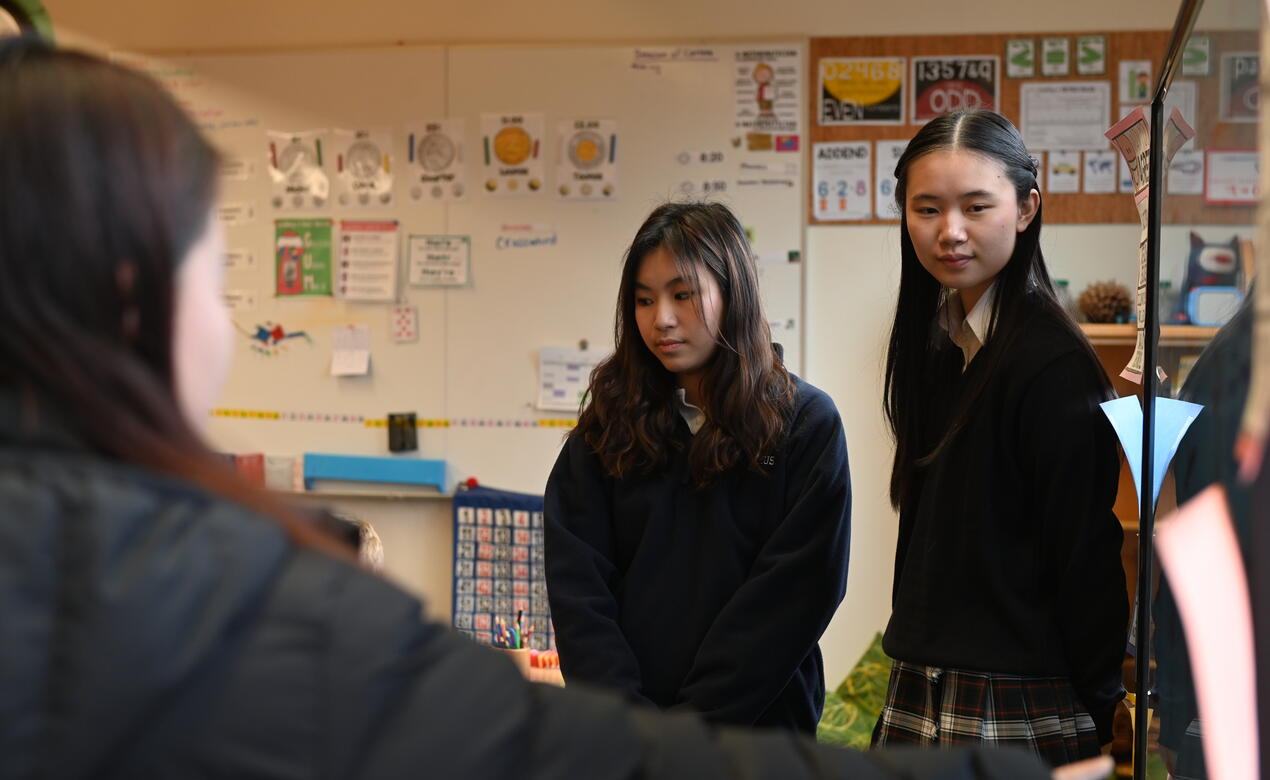
One of our current AP Research students, Cindy Chen, credited her admission into Stanford University this fall partially due to her taking AP Research this year. Cindy noted that up to half of her questions from the Stanford Alumni interviewer focused on her research methods and results, leading to the Stanford admissions officer complimenting her research journey.
Another AP Research student, Ruby Dieringer, commented on the course as follows:
“I enjoyed the way that I was able to fully independently pick my own topic and explore it on my own terms on an only semi-guided timeline. I really liked the way that you can take the course in whichever direction you wish, and you can go as deep as you wish. The level of freedom really motivated me to ‘make the course my own’ and do something I was actually interested in, so it felt less like homework and more like a passion project!”
Ultimately, as the school celebrates 10 years of delivering the AP Capstone program, SMUS is now regarded as a flagship school for the AP Seminar and AP Research courses across Canada, particularly in terms of student participation and the program's high success rate.
Over the past decade, the program has provided students with opportunities to develop lifelong research skills while pursuing topics they are genuinely passionate about. The research journey each student undertakes is unique within the high school setting and often leads to continued exploration of their chosen topic at the university level and beyond.
These courses develop skills students will need to thrive in post-secondary studies. Their ability to think critically about what they are reading allows them to grow as learners.
David Kerr