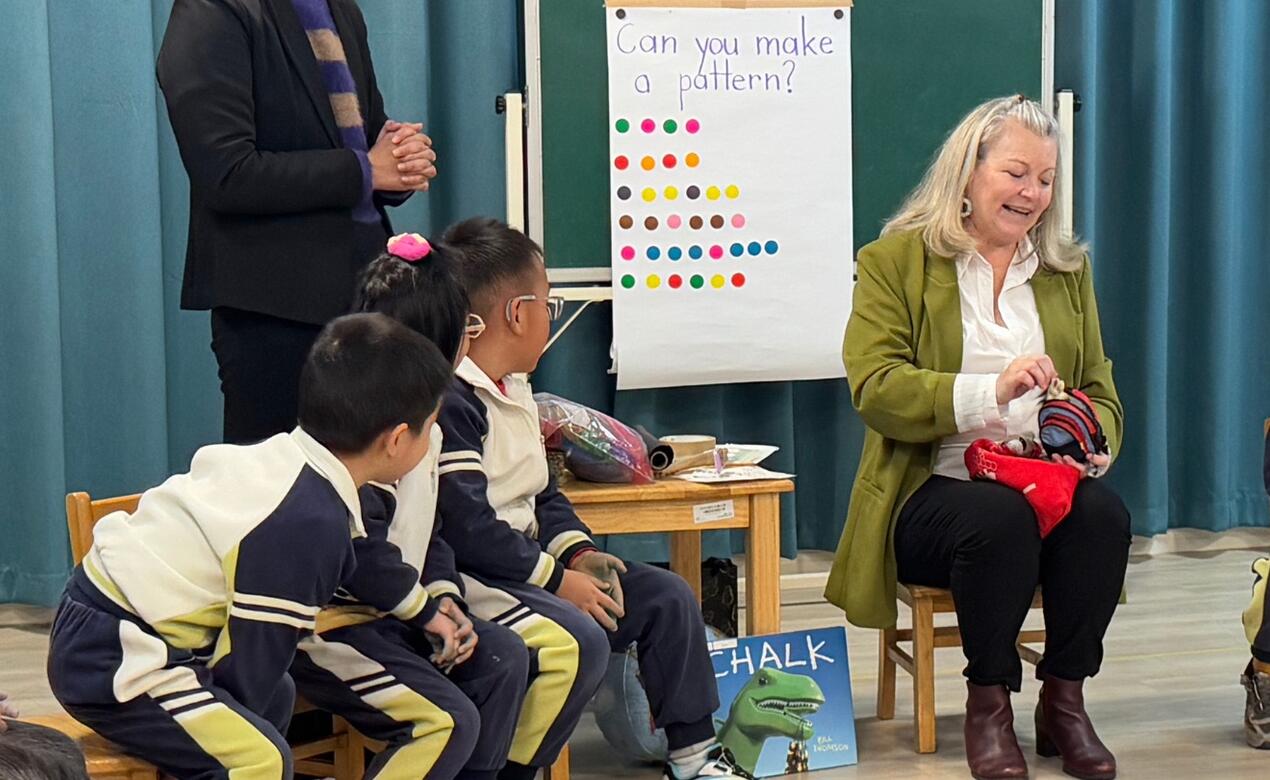

When educators leave St. Michaels University School, the thinking they helped shape often continues to travel with them. For former SMUS teacher Margaret Lincoln, a recent Global Educational Exchange to Nanjing, China provided an opportunity to extend Reggio-inspired practice developed over years of work in Canadian classrooms into an international professional context.
Invited to design and lead a learning experience for kindergarten principals, directors, and educators, Lincoln’s workshops focused on Canadian Early Learning Frameworks and the role of play as a vehicle for learning.
“So many extraordinary teaching and learning moments with SMUS Kindergarten students over the years allowed me to convey Reggio-inspired practice through wonderful and inspiring examples,” Lincoln reflected.
Rather than offering prescriptive models, she guided participants through inquiry-based approaches that position teachers as facilitators, observers, and co-researchers — the core differentiator of the Reggio approach and a model well under way in the early learning years at SMUS.
Throughout her time in China, Lincoln worked alongside kindergarten leaders and educators from across the region, exploring how learning can emerge from children’s interests and curiosities rather than predetermined outcomes. Sessions examined how children are innately capable and competent, with participants collaborating on ways to ask more open-ended questions, support agency, and design learning experiences that respond to children’s thinking.
“I welcomed this global exchange as it afforded me the opportunity to consolidate and articulate my own professional understanding and communicate the ‘why’, not just the ‘how’,” Lincoln shared. “I realized just how powerfully the Reggio Approach has influenced pedagogical work internationally.”
Discussions around outdoor learning generated particular interest. Educators were inspired by examples drawn from SMUS’s Junior School, where outdoor environments are used as dynamic spaces for inquiry and connection, and explored how similar approaches might be adapted within their own contexts.
As part of the exchange, educators came together to share and examine Reggio-inspired practice across contexts, supported by visits to local kindergarten classrooms. These visits reinforced shared values across cultures, including a strong emphasis on expressive arts, materials exploration, and respect for children’s creativity and competence.
“This experience reminded me that early childhood education is a deeply intellectual and ethical profession, shared across cultures,” Lincoln reflected. “I returned with a renewed sense of purpose, inspired to continue advocating for early childhood education.”