
The Royal BC Museum hosted Heritage Fair presentations by 75 St. Michaels University School Grade 8 students on April 29, showcasing research into BC history between 1871 and 1971. Guided by the theme "Closer to Home," students explored local landmarks, historical events and personal family stories, presenting their findings to SMUS staff, parents and members of the public.
"We started looking at those pictures, trying to guess what the story was behind them," said Leah Judd, a Humanities, Communication and Media Design teacher in the Middle School, describing how the project began with a collection of archival photos stripped of context. What followed was months of research spanning archives, museums, history books and family conversations.
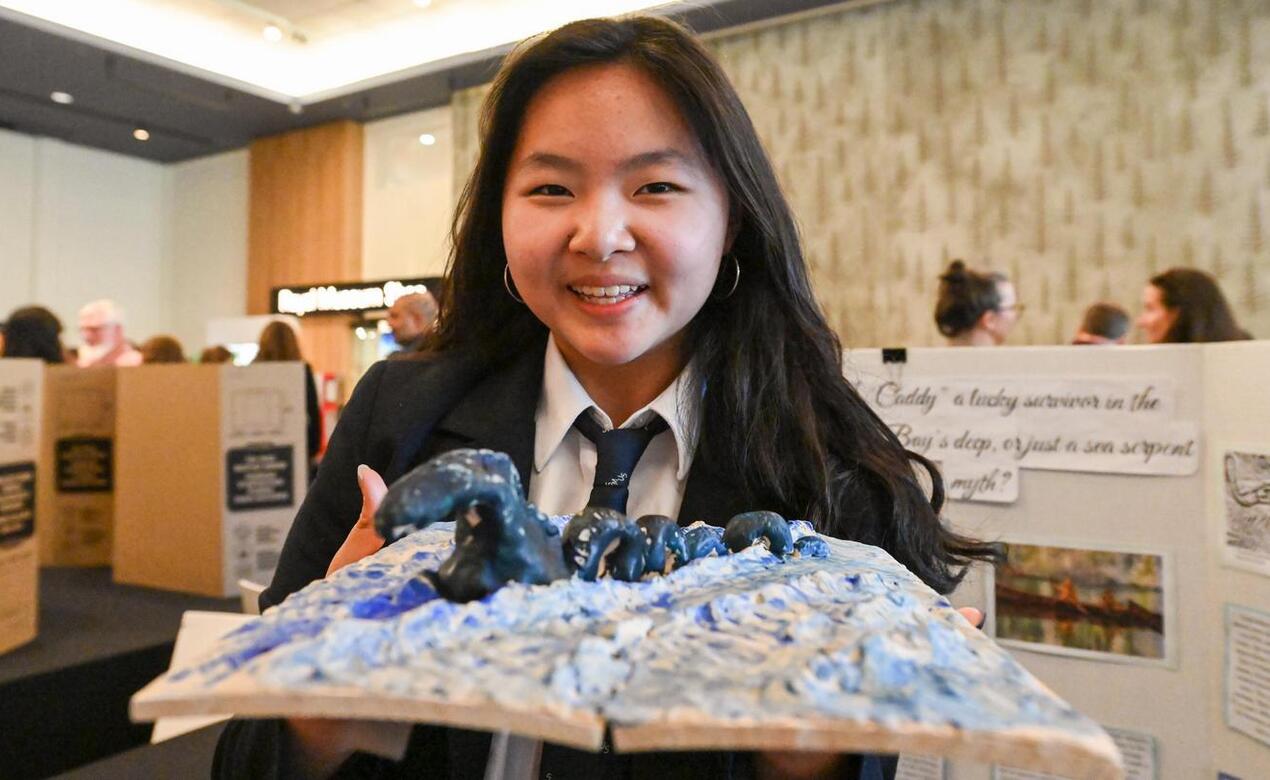
The range was wide. Projects examined topics ranging from the Empress Hotel, the whaling industry and rum running to Japanese Canadian internment, the nursing sisters of Victoria who served in WWI and the anti-Asian riots of 1907, among many others. One student investigated the life of Sir Arthur Currie, a Victoria schoolteacher who rose to command the entire Canadian Corps in WWI and whose name now lives on in the Bay Street Armoury. Another asked whether "Caddy," the mythical Cadborosaurus sea serpent of Cadboro Bay, was a prehistoric survivor or simply local legend.
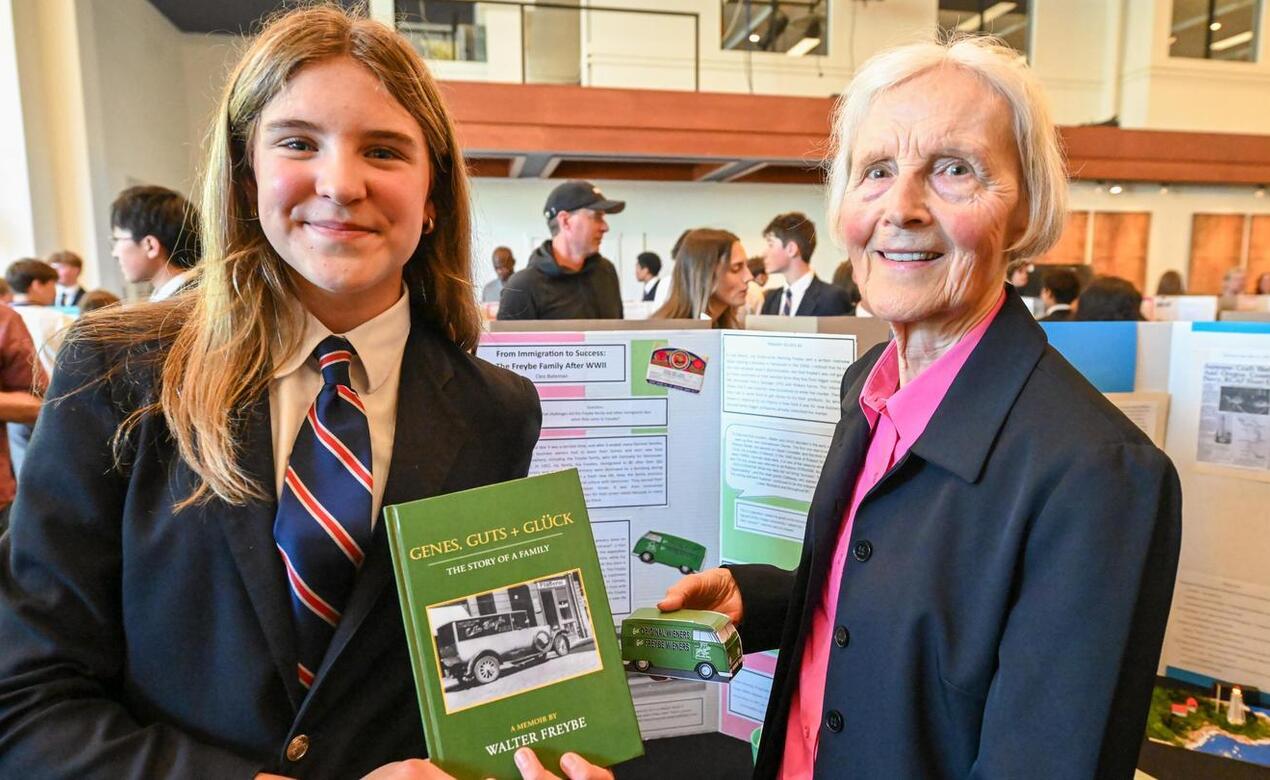
Every project required an artifact. Sarah E. recreated a pocket watch connected to the Great Vancouver Fire, sourcing one and deliberately burning it to crack the glass. Marcus D. built the Lego Milky Way set as the artifact for his project on the Dominion Astrophysical Observatory, the Victoria institution that was once home to the largest telescope in the world. Cleo B. interviewed her great-uncle Henning about her family's immigration from postwar Germany, tracing how the Freybes rebuilt their business in Vancouver after their factory was destroyed in the Second World War.
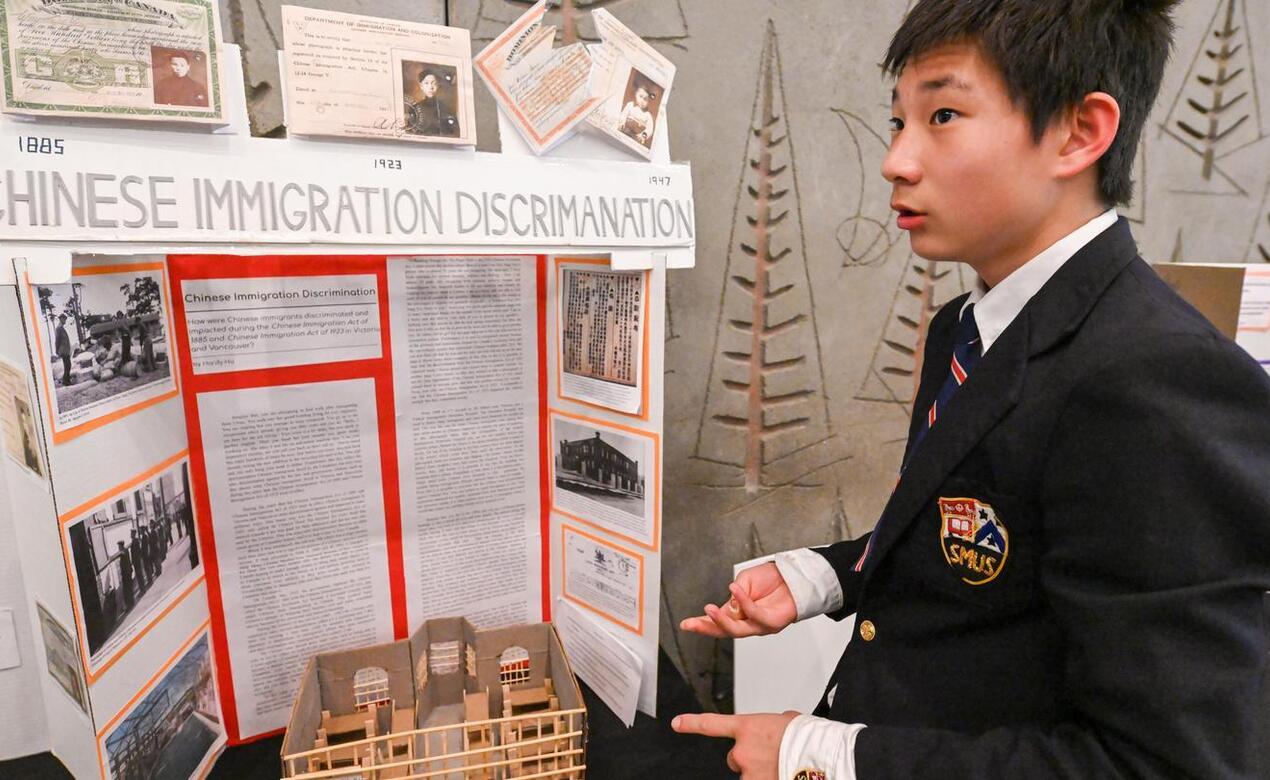
Hardy H.'s project on Chinese immigration discrimination between 1885 and 1947 included archival photos of segregated swimming pools, documentation of restrictive property covenants, and images of the detention facility where immigrants were held up to 24 to a cell. His handmade artifact was a model of that building. He had visited the Chinese Museum and spoken with people there as part of his research.
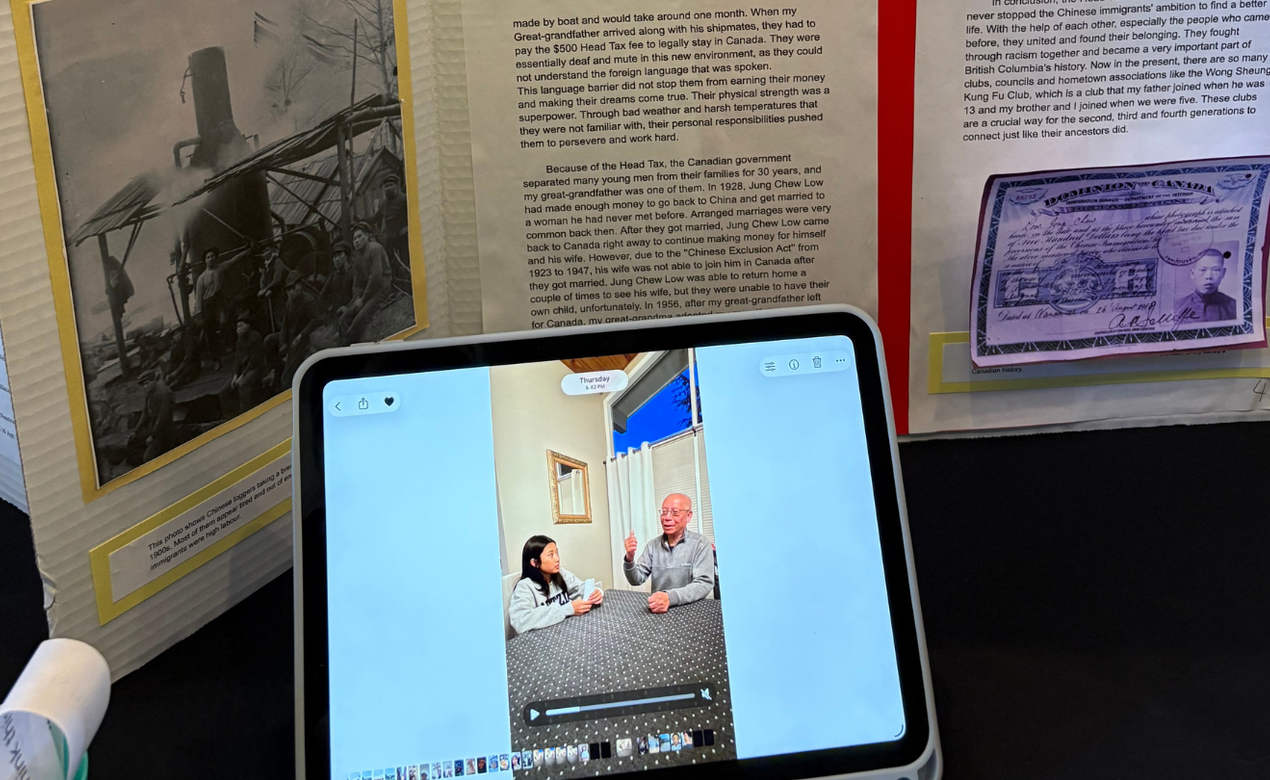
Jade L.'s project on the Chinese Immigration Act of 1885 traced her own family directly. Her great-grandfather, Jung Chew Low, arrived from Guangdong, China, in 1918 and paid the $500 Head Tax, equivalent to $16,000 today. His receipt is held at the Victoria Chinatown Museum. The Act kept him separated from his family for years. His son, Jade's grandfather, eventually came to Canada alone by boat, a three-month crossing. Passengers survived on preserved salted eggs.
Jade had recorded a video interview with her grandfather for the project, and the iPad playing it sat propped in front of her board. She said she wouldn't have known any of it without the questions the project made her ask.
For some students, the research closed the distance between a history assignment and their own family story. Judd noted that BC history at this depth is not typically part of the Grade 8 curriculum. For many of her students, the discoveries were ones they would never have made otherwise, whether that meant discovering that the city once ran on an entire streetcar network, finding that a beloved local business was rebuilt from the rubble of a world war, or uncovering the human cost behind a law they had never heard of.
For students and visitors alike, the Heritage Fair projects added a new layer to the city they thought they already knew.

Grade 8 SMUS students Heritage Fair at Royal BC Museum

Grade 8 SMUS students Heritage Fair at Royal BC Museum

Grade 8 SMUS students Heritage Fair at Royal BC Museum

Grade 8 SMUS students Heritage Fair at Royal BC Museum

Grade 8 SMUS students Heritage Fair at Royal BC Museum

Grade 8 SMUS students Heritage Fair at Royal BC Museum

Grade 8 SMUS students Heritage Fair at Royal BC Museum

Grade 8 SMUS students Heritage Fair at Royal BC Museum

Grade 8 SMUS students Heritage Fair at Royal BC Museum

Grade 8 SMUS students Heritage Fair at Royal BC Museum

Grade 8 SMUS students Heritage Fair at Royal BC Museum


