
In May, over the span of three days, 15 St. Michaels University School's staff and faculty from across Junior, Middle and Senior School and various specialty areas made their way to the West Coast of Vancouver Island. That group spent dedicated time with Indigenous Scholar, Gisele Martin of Tla-o-qui-aht First Nation, to further their understanding and appreciation of Indigenous ways of knowing. This school year is the first year for Gisele and SMUS and she has already contributed greatly across the SMUS community. She has already made an impact with students in their work across Environmental Science, English First Peoples, Criminology, Outdoor Education, Choir, and Grade classes. The land-based experience for this particular group of staff and faculty is part of SMUS's ongoing commitment to Indigenous Connections, and in support of the Faculty as they fulfill Ministry of Education expectations around Indigenous content.
Below are reflections from Indigenous Liasion Keven Fletcher.
The view from the mudflat is serene. Hills of varying heights and distances shape the horizon. Clouds shift above as solitary drops of rain hint that more will soon come. Fifteen staff sit in well spaced silence, accepting the invitation to spend about twenty minutes contemplating a single plant or shape on the horizon.
How different from standard professional development, delivered in banquet halls and breakout rooms with colleagues tightly packed, often centred on individuals in front of microphones offering up what can feel like an endless cascade of thoughts, each session set to begin and conclude at a precisely stated time.
Both styles have their place, but it’s the former that often feels out of reach. It’s relatively easy to send staff to a tightly formatted event that promises to offer “the top five considerations” or “the seven essential elements” on any given topic. It’s quite another to make room for an experience that offers space to explore another way of being.
Under the thoughtful guidance of Gisele Martin, we found ourselves immersed in land-based learning. After being greeted by Gisele and her sister, Tsimka, at the edge of Tla-o-qui-aht territory, we eventually wandered the Big Tree trail on Meares Island and the Tonquin trail out of Tofino. Later, we met her much respected father Joe Martin in the Naa’waya’sum Gardens of Clayoquot Campus. Along the way we heard stories that revealed relationships, complexities of local histories, linguistic patterns, food and plant care, the tie between art and memory, and traditional understandings of how we might view the world and our life together. There is no word in Nuu-chah-nulth for “sorry”; only a change in behaviour conveys the message.
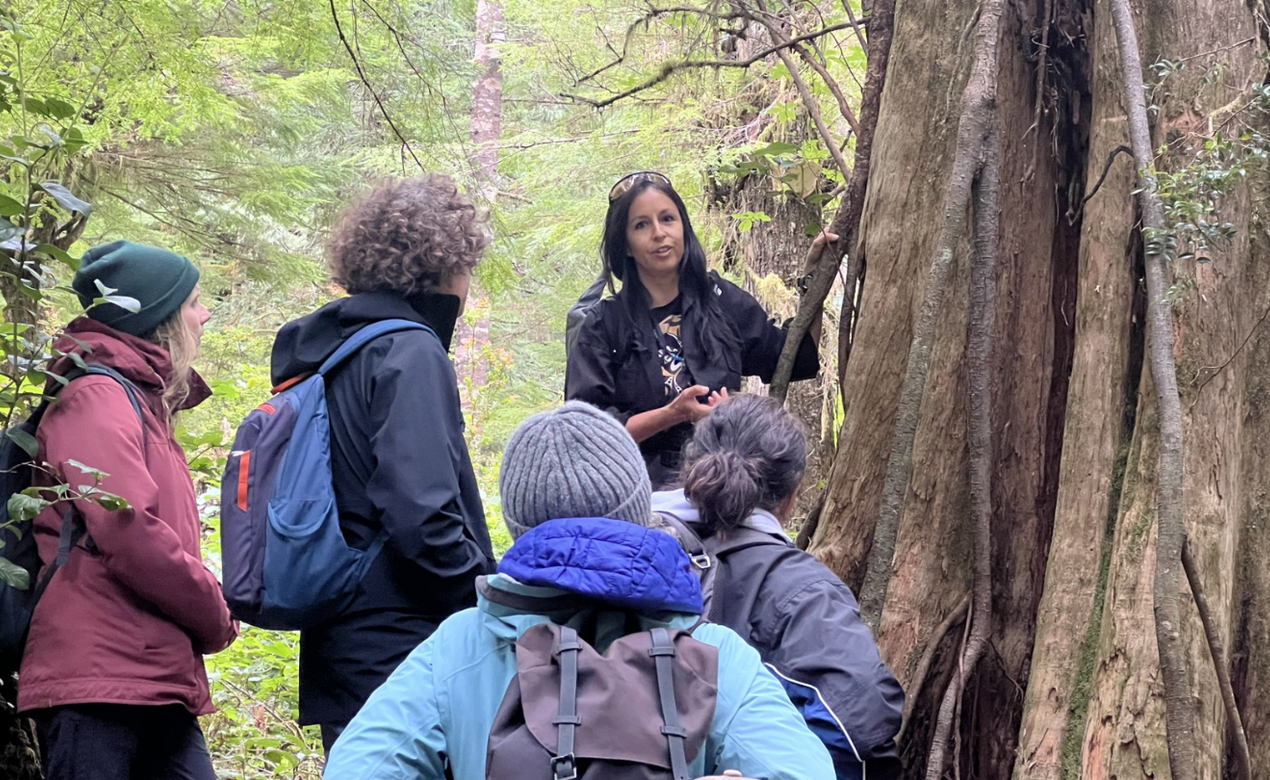
At our final gathering in the lodge we had much to note about our three days. Colleagues spoke about how there were facts they knew through study, but now their eyes were opening to deeper layers of meaning. Others commented on how accustomed they were to reacting immediately to anything that happens, good or bad, and how they were beginning to see value in taking time to “observe, appreciate, and act accordingly”. Some reflected on the impact of learning practices focussed on showing, rather than telling, along with the salving effect of humour. Many talked about how our experience was tiring in a good way, and how their side conversations along trails were personally and professionally enriching. There were comments about having been to great conferences, but nothing like this. One suggested that the time had been as much about spiritual development as professional, tied to how we show up for students and colleagues alike.
We will gather again in October 2026 but this time on campus. We will share what we have “observed” about ourselves and our teaching since the trip, “appreciate” the joys and challenges of the work, and test the degree to which we have “acted accordingly”, because it’s the change in behaviour that ultimately conveys our message, and shapes the experience of students.

Faculty Pro-D Indigenous Learning Meares Island

Faculty Pro-D Indigenous Learning Meares Island

Faculty Pro-D Indigenous Learning Meares Island

Faculty Pro-D Indigenous Learning Meares Island

Faculty Pro-D Indigenous Learning Meares Island

Faculty Pro-D Indigenous Learning Meares Island