
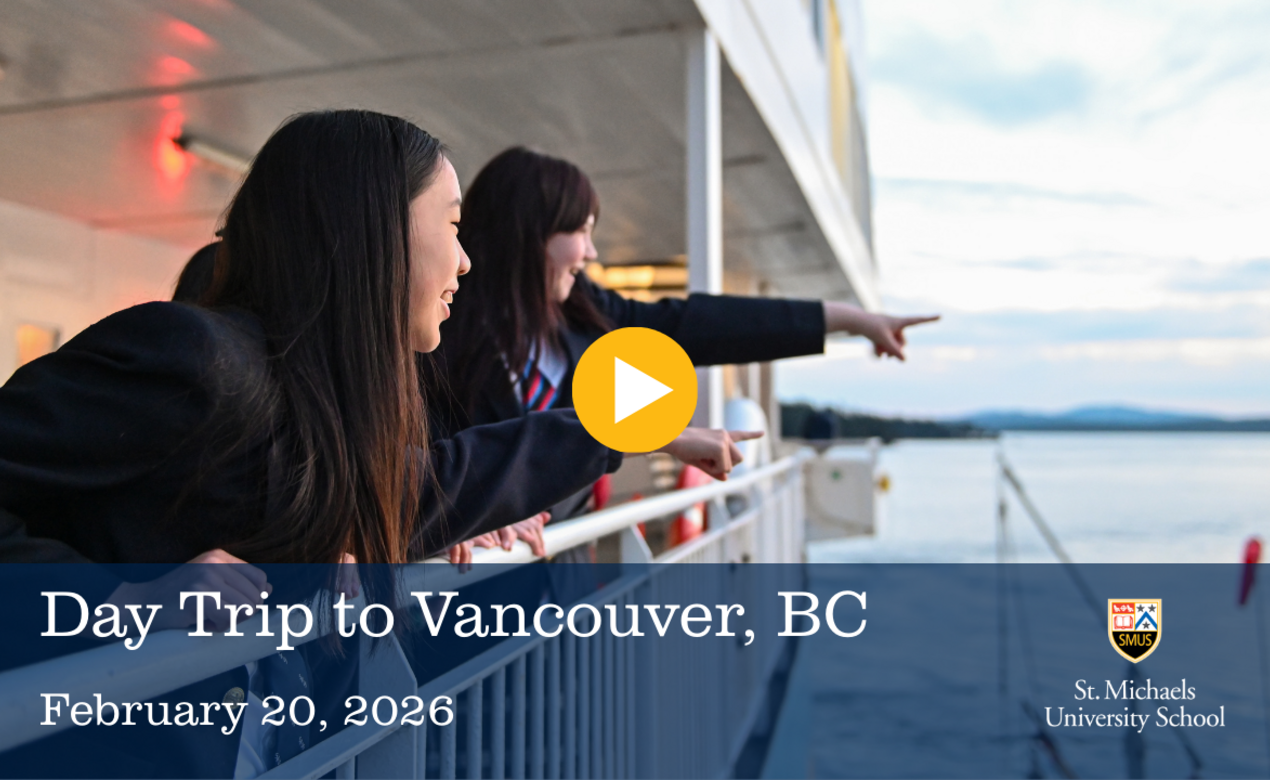
On Feb. 20, students from the St. Michaels University School's Middle and Senior School Sustainability councils took part in ReGeneration Rising: Cultivating Hope and Action, the annual Independent Schools Association of British Columbia (ISABC) Youth Sustainability Conference. Hosted at the the University of British Columbia in Vancouver, British Columbia, the full‑day event brought together youth from across the province who share a commitment to climate action, environmental justice, and growing a sustainable future.
SMUS students attended alongside faculty mentors Craig Farish, Head of Outdoor Education and Sustainability Coordinator; Valerie Pike, Middle School French teacher and Sustainability Co-Lead; and Susan Vachon, Middle School Humanities teacher and Sustainability Co-Lead. Together, they joined hundreds of students for a day of learning, collaboration, and hands‑on exploration.
The conference opened and closed with gatherings that brought all ISABC schools together, framing the day around the shared goal of empowering youth to become environmental advocates in their communities. In between, students attended workshop blocks, selecting sessions that aligned with their own passions and curiosities. Options ranged widely from engineering green cities and research‑driven scientific presentations to zero‑waste baking, clothing upcycling, and cocoon jewelry making.
For Senior School Sustainability Council heads Natalie Chan and Ashley Baek, the diversity of presenters and workshop themes was a highlight. They were especially eager to attend sessions on how social media can expand sustainable impact and a session exploring the native bees of British Columbia. Another memorable workshop was led by a UBC student from Seoul, Korea, who shared a powerful personal account of living with severe urban air pollution and the importance of youth advocacy in shaping environmental policy.
A significant number of SMUS students spoke about the connections they made throughout the day—meeting like‑minded peers from other schools and exchanging ideas for real‑world initiatives. Many returned with memorable facts, such as learning that orcas are born with whiskers, and with new strategies for making sustainability projects more fun and engaging.
These conversations were especially meaningful given the work the SMUS Sustainability Councils have already accomplished this school year. Students have led several initiatives, including a popular clothing swap promoting circular fashion, a sustainability‑themed bake sale, and the successful introduction of reusable cups at Howard’s Café to reduce single‑use waste. The conference offered an opportunity to deepen and expand this momentum, sparking new ideas for future projects.
SMUS faculty also played a role in the learning. Craig Farish presented an engaging workshop titled “Greening Your School: How to Find and Prioritize Initiatives.” Drawing on his personal and professional experience, he explored how sustainability involves both technical and social dimensions, such as improving waste‑sorting systems, but also ensuring the community adopts them. Farish shared a case study from his own home energy audit, as well as the Grade 12 student‑led solar panel installation on Brown Hall, illustrating how meaningful change emerges from well‑chosen, thoughtfully executed projects. His workshop concluded with reflective conversations among students from different schools about the challenges they face in launching environmental initiatives.
For SMUS, attending ReGeneration Rising was more than a field trip. It reinforced the school’s belief that sustainability is a shared responsibility, woven into daily life and long‑term planning. The conference served as a reminder that when young people are given the tools, connections, and encouragement to lead, they rise to the challenge with creativity and optimism.
As students returned to campus with new ideas and renewed motivation, the day stood as a powerful reflection of SMUS’s ongoing commitment to youth advocacy, climate action, and building a more sustainable future. With Earth Week approaching in April, they are eager to bring what they learned into upcoming projects and events. One initiative, one conversation, and one inspired student at a time.