

When Math and Science teacher Riley Doland set out to design a math project for Grade 6 students at St. Michaels University School, she wanted students to experience mathematics the way it is used in the real world: analyzing data, working within constraints, and making decisions where the outcomes matter.
The result was STEAMScape, a project in which students used math, budgeting, and spatial planning to design a conceptual outdoor learning and play space, justifying each decision through data, measurement, and financial constraints.
"The primary goal for the students has been to use math to help make informed design decisions," said Doland. "Instead of just learning formulas in isolation, they used math practically."
Before any design work began, students conducted a school-wide survey of the broader Middle School community. With 143 responses, the data provided each design group with a real starting point and an important lesson: effective design begins with research. Understanding how people behave, what they need, and what they value has to come before any decisions about features, layout, or budget.
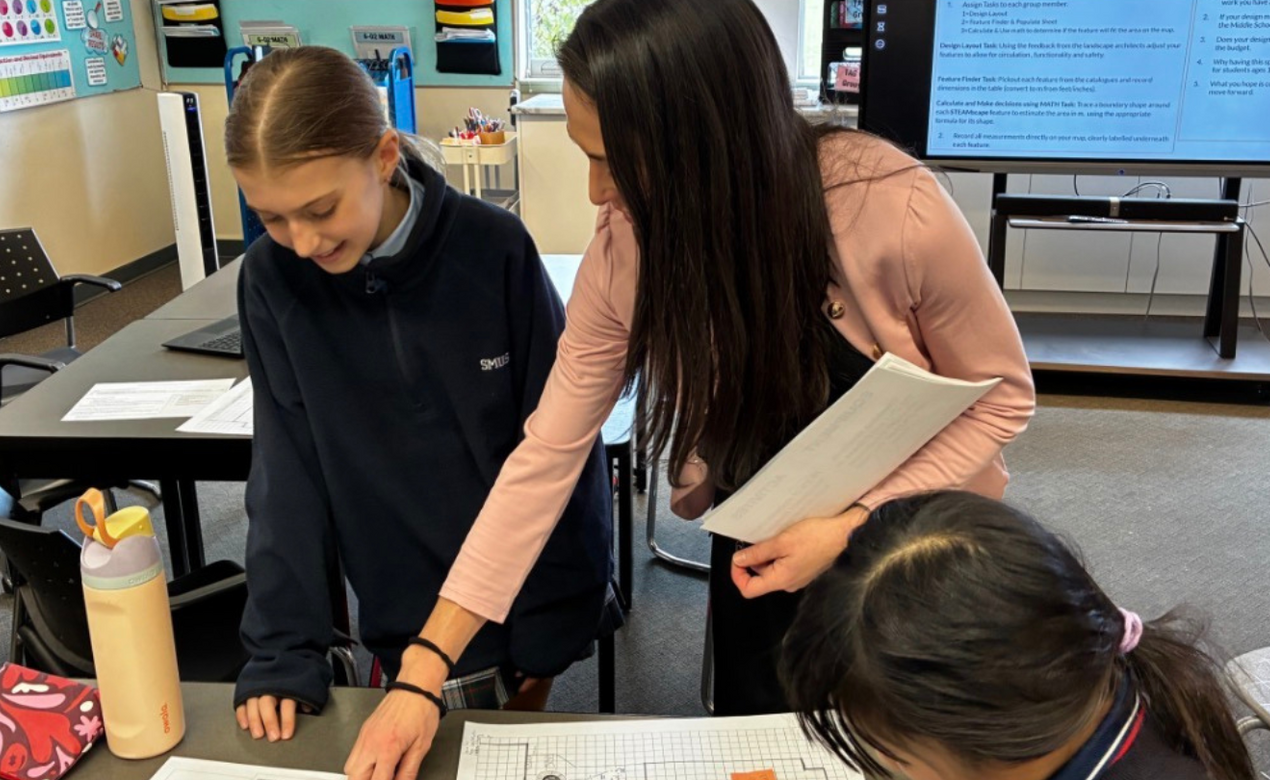
Math as a Decision-Making Tool
That practice stretched across the entire school year. Students worked through operations with decimals, area and perimeter, scale, proportional reasoning, and financial literacy, all tied directly to the design work. They used ArcGIS mapping software, the same professional tool used by the school's landscape architects, to explore the campus footprint and measure potential sites. They calculated areas using formulas for rectangles, triangles, and compound shapes, built budgets that accounted for GST and PST, and learned quickly that dream features had real price tags.
A single basketball court, students discovered, could account for nearly half the total budget. That kind of constraint forced genuine decision-making: groups had to weigh one feature against another, consider existing surface types to reduce costs, and revise layouts that looked good on paper but didn't hold up under scrutiny.
Landscape architect Devin Tepleski came in to review student designs and offer feedback that moved the project beyond the classroom. He spoke to groups about circulation, slope, and how existing surface types could inform smarter, more cost-effective feature placement. For many students, it was their first experience presenting work to a professional and revising it based on expert critique.
"It validated their ideas, pushed their mathematical thinking on spatial realities, and gave them a taste of how real-world architecture and community development operate," Doland said.
Learning from the Land
SMUS Groundskeeper Colin Craveiro added another layer. After touring the Richmond Road campus with Indigenous Elders, Craveiro spoke to students about the plant life already growing there and its significance within Coast Salish teachings. Students began incorporating rain gardens and Indigenous plant species into their designs, thinking about the outdoor space not just as somewhere to be active, but as a place to learn from the land.
The session shifted how many students thought about the natural elements in their designs. Rather than treating greenery as decoration, groups began positioning Indigenous plants as deliberate features, buffers between activity zones, places to pause, and living connections to the history of the land the school occupies.
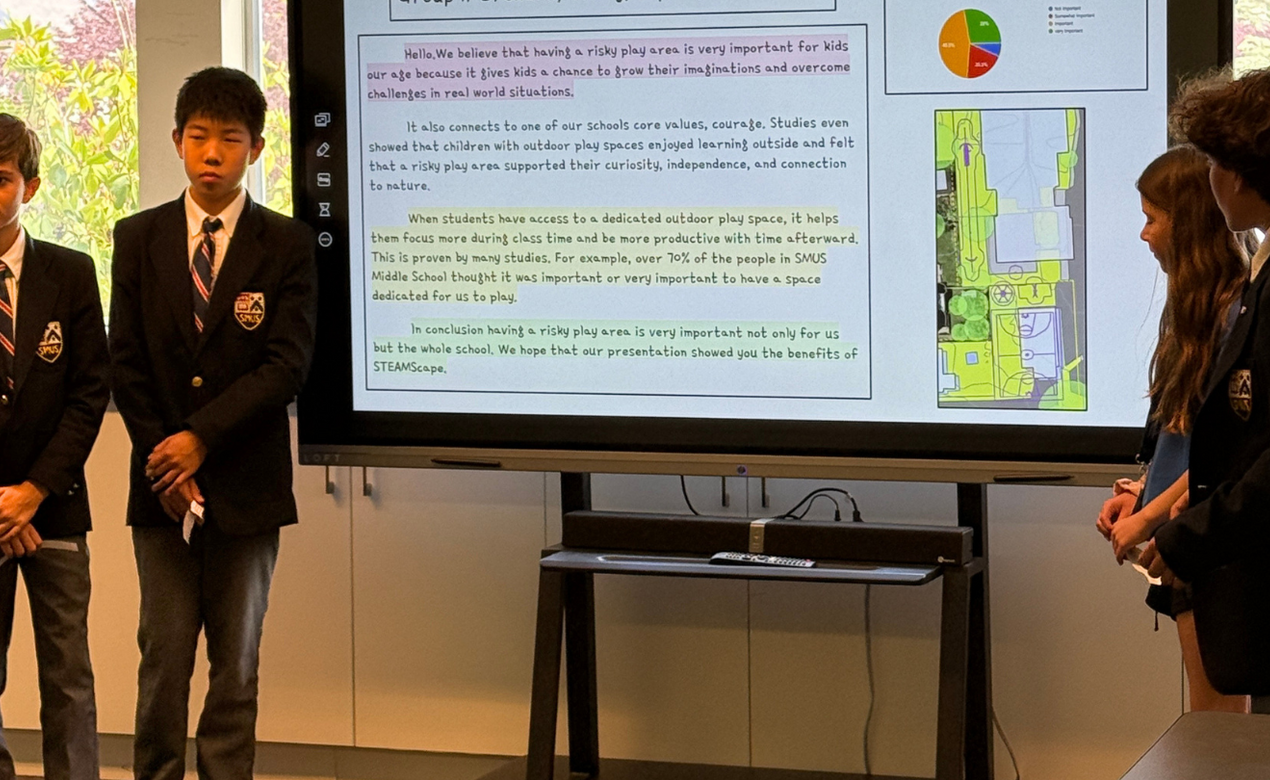
Presenting the Work
When students brought their designs together in elevator pitches, the depth of thinking behind the work came through clearly. Ashwin C., Martin S., Maya B., and Anya L. came to their presentation with a chart mapping specific playground equipment to heart rate ranges and nervous system responses, noting that swings produced a parasympathetic, calming effect while monkey bars drove heart rates to peak sympathetic exertion. Brendan E., Brady G., Sophia L., and Jayson D. connected their design directly to one of SMUS's core values, arguing that a space built around risky play was fundamentally an expression of courage. Evelyn E., Abigail P., Michael Y., and Branson B. described their vision simply and well: a space where science, math, and imagination meet play.
The project is designed to be exploratory, a genuine exercise in possibility rather than a formal proposal, and Doland has been clear with students that the value of working through a real-world problem at this level of rigour stands on its own terms.
The project is expected to continue with incoming Grade 6 students, with the current cohort potentially building on their work in Grade 7. Whatever form it takes, the core experience will be the same: when the math is tied to something tangible, something you can map, measure, and discover for yourself, it has a way of meaning more.


