

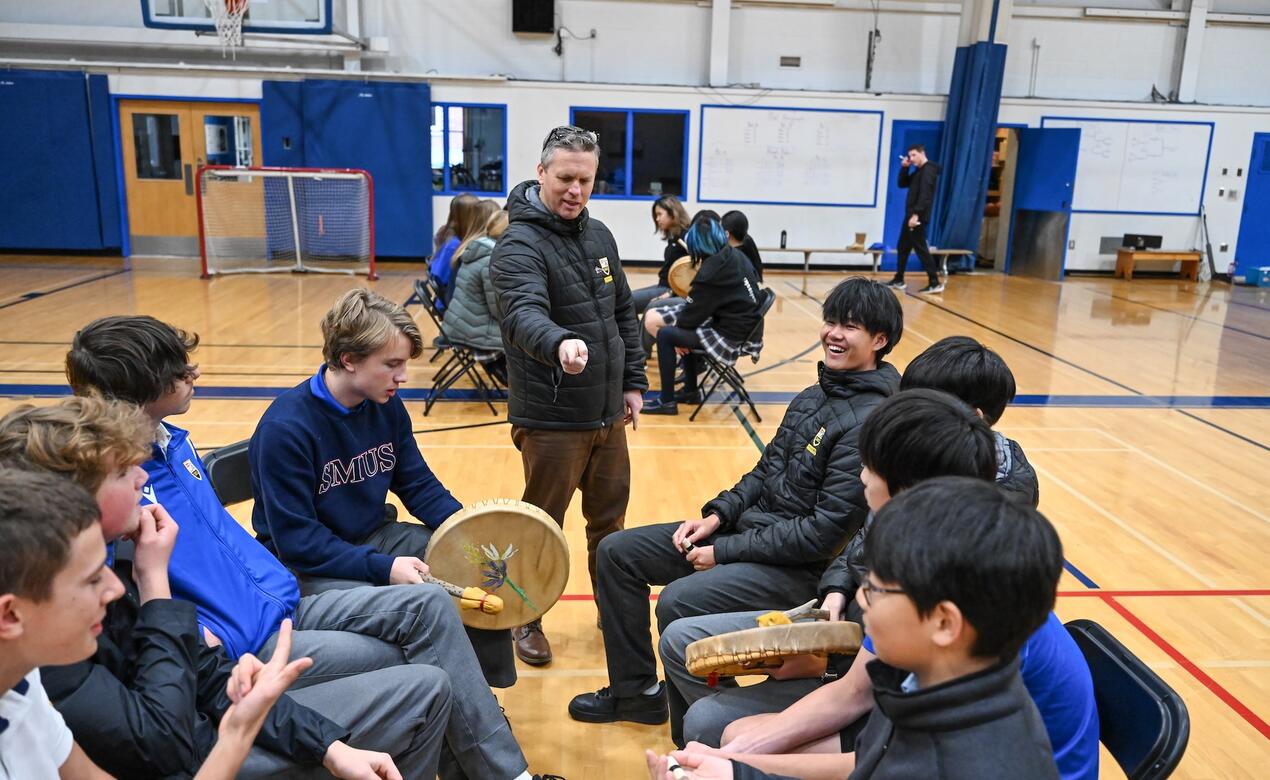
Two teams sit facing one another. On one side, players hide marked and unmarked bones in their closed fists. Across from them, a guesser uses a hand signal to show where they think the unmarked bones are. A wrong guess costs a scoring stick. Once both unmarked bones are found, the teams switch roles.
That’s how a round of Lahal begins in the version Grade 10 students learned at St. Michaels University School. Also known as the bone game, Lahal is a traditional game that requires participants to read an opponent's spirit as much as raw probability. It's played across the Pacific Northwest Coast, particularly among Coast Salish communities. Rules and songs vary by community. The team hiding the bones may sing and drum as they play, building rhythm and energy while giving the opposing team something else to pay attention to. Played across generations, Lahal continues to bring people together at community gatherings, celebrations and tournaments.
Grade 10 Physical and Health Education classes taught by Kelsey Boudreau and Brady Doland joined Ryan Dewar’s Grade 10 Experiential Program students for two classes. They spent the first learning how to play and taking time to understand the game’s cultural significance. By the second class, they were playing a full tournament.
“Lahal has been such a fun and engaging way for students to connect and collaborate across subject areas,” said Boudreau. “Students really leaned into the experience, bringing enthusiasm and energy to each game. Along the way, they had opportunities to strengthen their communication skills, work together, and step into leadership roles.”
From a Teacher Workshop to a Grade 10 Tournament
The idea took shape last June, when teachers from Physical and Health Education and English First Peoples spent an afternoon learning from Knowledge Holders, Willie Pierre (Katzie) and Rose Gray (Snuneymuxw), along with our Titumels and Guide, Bill White (Snuneymuxw). They shared how to play Lahal, emphasizing its history, cultural significance, and protocols. The teachers have been fortunate to benefit from their wisdom and guidance. The afternoon with them became the basis of the approach, now captured in a teaching guide.
The collaboration adds another example of how Indigenous learning continues to find its place across and within the school. In PHE classes, students could learn about a living Indigenous tradition by taking part in it, using the same skills they practice in other games as they watched their opponents, communicated with teammates and worked out a strategy together.