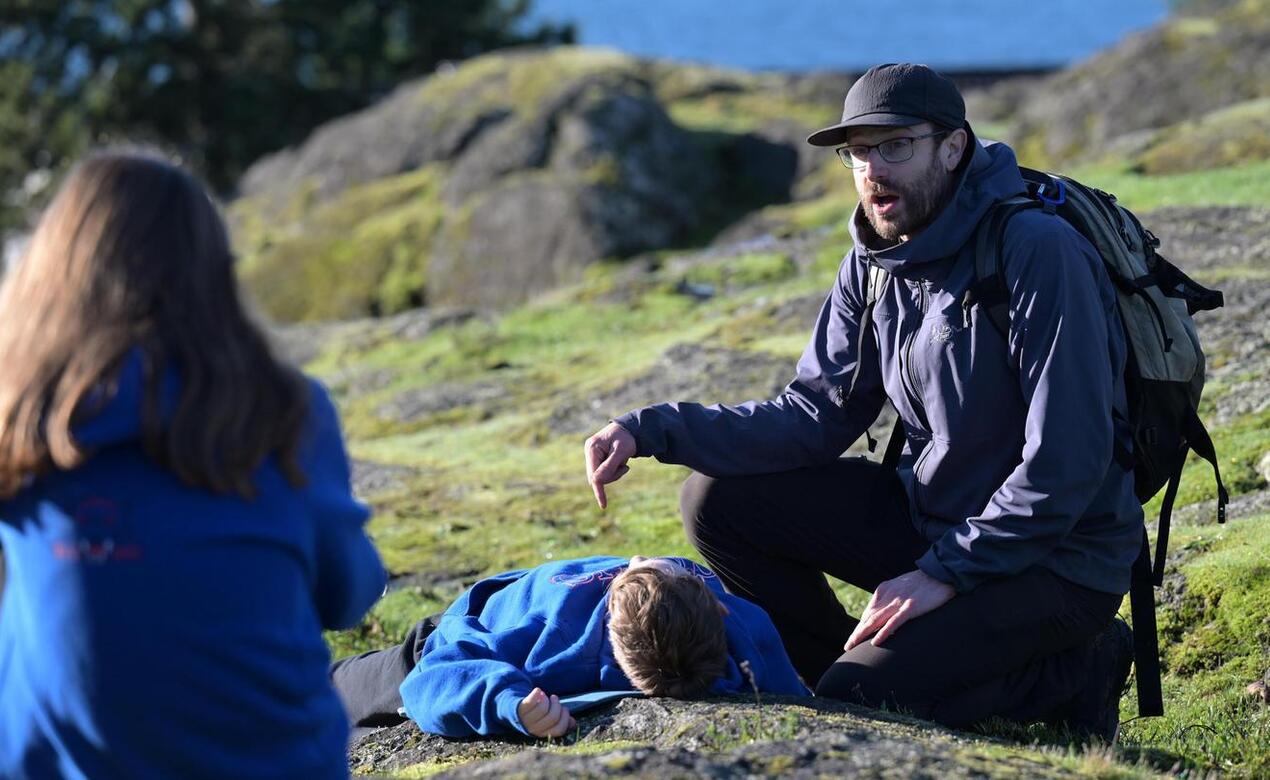

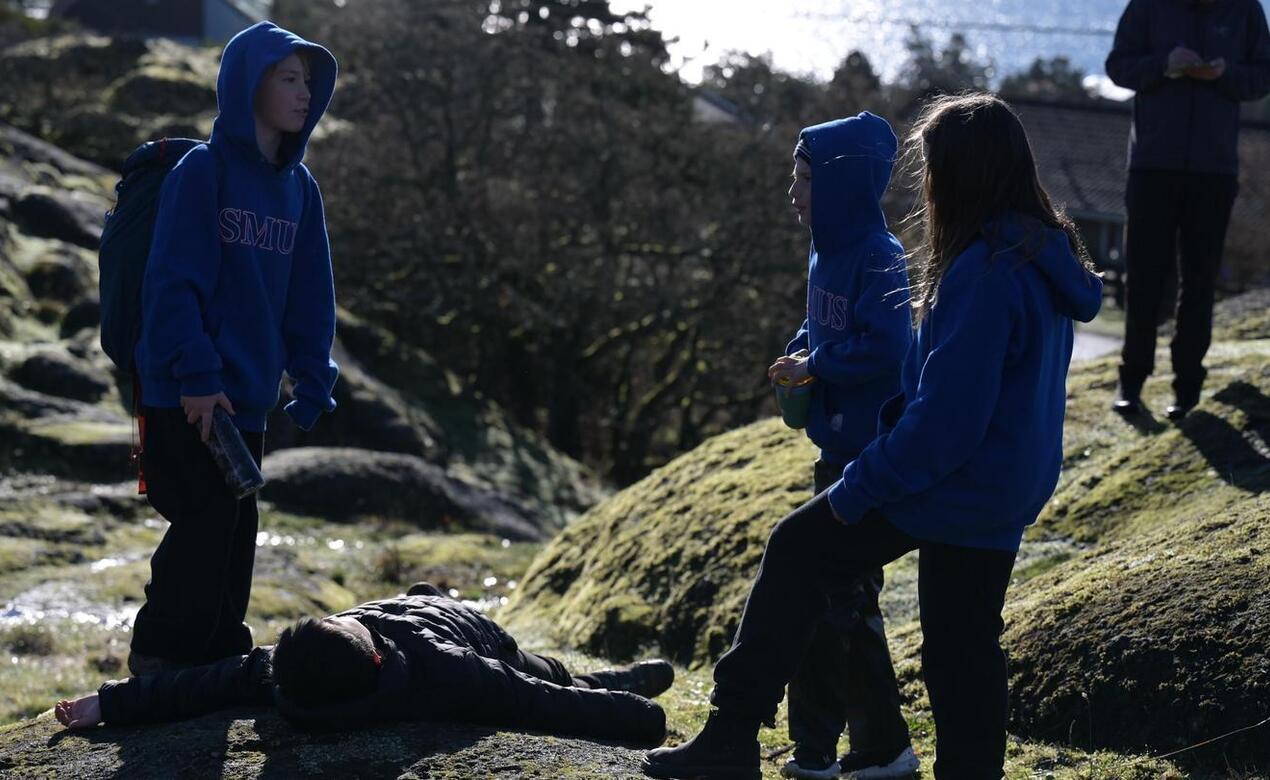
Scattered across the rugged terrain of a hilltop overlooking the Juan de Fuca Strait, several St. Michaels University School Grade 5 students lay still, each experiencing a different medical emergency. They waited quietly to be discovered by their classmates, who would assess their condition, decide on next steps, and call for emergency responders.
Scenes like this unfolded midway through an Outdoor Education lesson focused on first aid after students had been carefully prepared to respond when someone needed help. Earlier in the lesson, students gathered around teacher Jamie Pope as one volunteer played the role of an unconscious patient. Pope introduced a simple, five-step framework that emphasized personal safety, careful observation, and methodical decision-making, asking students to repeat each step aloud during review.
From Preparation to Practice
Once students understood the framework, the lesson moved from demonstration to application. Students broke into small response teams, while several classmates headed off to become “victims,” spreading out across the mossy, uneven hillside. As teams worked through the scenarios, learning became collaborative and dynamic. When a step was missed, teammates offered calm reminders, reinforcing the idea that emergency response is rarely a solo effort and that clear communication matters.
For many students, the clear structure helped them stay focused under pressure. Sophie noted that knowing the five steps was important, while Neha added that remembering the ABCs — checking airway, breathing, and circulation — helped guide what to do next.
Boden captured one of the most important takeaways. “It’s important to check the area and look around for any dangers,” he said. “If there’s a puddle with a wire in it, you might be electrocuted and then you can’t help anyone.”
In one scenario designed to challenge students in a different way, some volunteers were asked to play combative patients. The shift introduced a higher level of noise and unpredictability, reflecting real situations where people in distress may be frightened, uncooperative, or unwilling to be touched. The focus remained on learning how to help without hands-on intervention, listening carefully, and respecting boundaries.
These scenarios are part of a multi-session approach that connects science, outdoor education, and emergency preparedness. During this term, students study human body systems, then begin applying that knowledge outdoors through first aid scenarios that increase in complexity over time.
“The Grade 5s already have a lot of outdoor skills by this point,” Associate Teacher Ben Hosios said. “We’re able to put everything together and build on what they’ve learned.”
Parent volunteer Shannon Gould, who recently moved to Victoria from Seattle, observed how different this approach feels from her previous school community. Outdoor education there, she said, was more of a once-a-year experience rather than an integrated program where skills build over time.
By the end of the lesson, students had rotated through roles, practiced multiple scenarios, and gathered once more to reflect. They had navigated uneven ground, communicated clearly with teammates, and made decisions under real-world conditions. Learning first aid this way encourages students to move beyond remembering what to do. It helps them build the awareness, judgment, and confidence they will carry with them when it matters most.