

From agriculture to environmental monitoring, systems that respond automatically to changing conditions are becoming increasingly common, and Grade 9 students at St. Michaels University School are learning how they work. As part of a Science and Applied Design, Skills, and Technologies (ADST) project, students designed and built automated water tower systems that water plants only when needed.
Drawing on concepts from physics, coding, and engineering, the project gave students hands-on experience designing responsive technology, while also hinting at how the same ideas could be adapted to other challenges beyond the classroom.
From Concept to Construction
While every group worked with the same materials and constraints, no two towers looked alike. Students designed and built structures that balanced function with structural integrity, each one tested through a shake test that sent unstable designs back for reinforcement and revision.
Inside the structures, sensors and programmed circuits worked together to control when water flowed and when it stopped. Some groups added features such as indicator lights or low-water warnings, but getting even the core system working required patience and persistence.
“We struggled a lot with our circuit at first,” one student reflected. “It wouldn’t connect properly, and the code wasn’t doing what we expected. We kept trying different things, asked for help, and eventually it worked.”
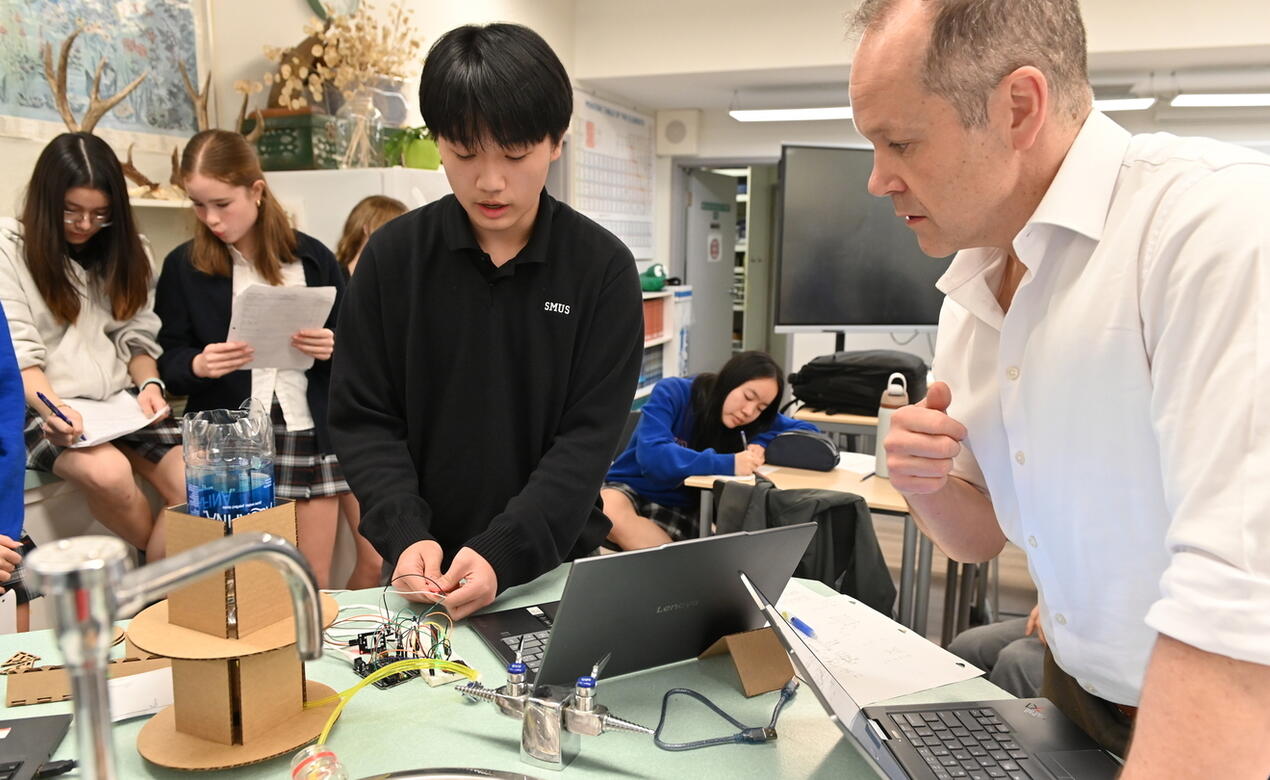
Teachers Dayton Preissl and Oliver Amiel both emphasized that these moments were central to the learning. Earlier in the term, students studied circuitry in Physics, learning about voltage, current, resistance, and circuit design. The water tower project asked them to apply that knowledge in real conditions, where materials don’t always behave as expected and solutions often emerge through trial and error.
“When it finally works, that is the moment,” said Physics teacher Mr. Preissl. “Students touch the sensor, the system responds, and there is usually a cheer. They have made something that does exactly what it’s supposed to do.”
Beyond the Build
What made this year’s project distinctive was the opportunity to ask what comes next. Once students had reliable systems in place, the focus shifted from building to investigation as the work extended into the ecology unit of Science.
“It’s not just about building it and making it work,” said Science teacher Mr. Amiel. “The next question is, now that we have this system, what else can we learn from it?”
Working in teams, students used their towers to explore questions related to plant growth and environmental conditions, testing variables such as soil quality, nutrients, or water composition. With all systems operating indoors, students were able to control external factors and focus on observing and comparing results over time.
The term-long project culminated in a showcase of final designs, where students reflected on the challenges they encountered and the decisions that shaped their work. More than a demonstration of technical skill, the experience highlighted how problem-solving, iteration, and adaptability come together when students are asked to think beyond a single solution. In that sense, the water towers marked not an endpoint, but a moment of insight into how ideas can grow, evolve, and be carried forward.

Grade 9 students design automated water towers

Grade 9 students design automated water towers

Grade 9 students design automated water towers

Grade 9 students design automated water towers

Grade 9 students design automated water towers

Grade 9 students design automated water towers

Grade 9 students design automated water towers


