

On Global School Play Day today, Feb. 4, schools around the world are setting aside their usual routines to make space for play, recognizing its essential role in children’s learning, well-being, and development. The day underscores a simple but powerful idea: play is not a break from learning, but a vital part of it.
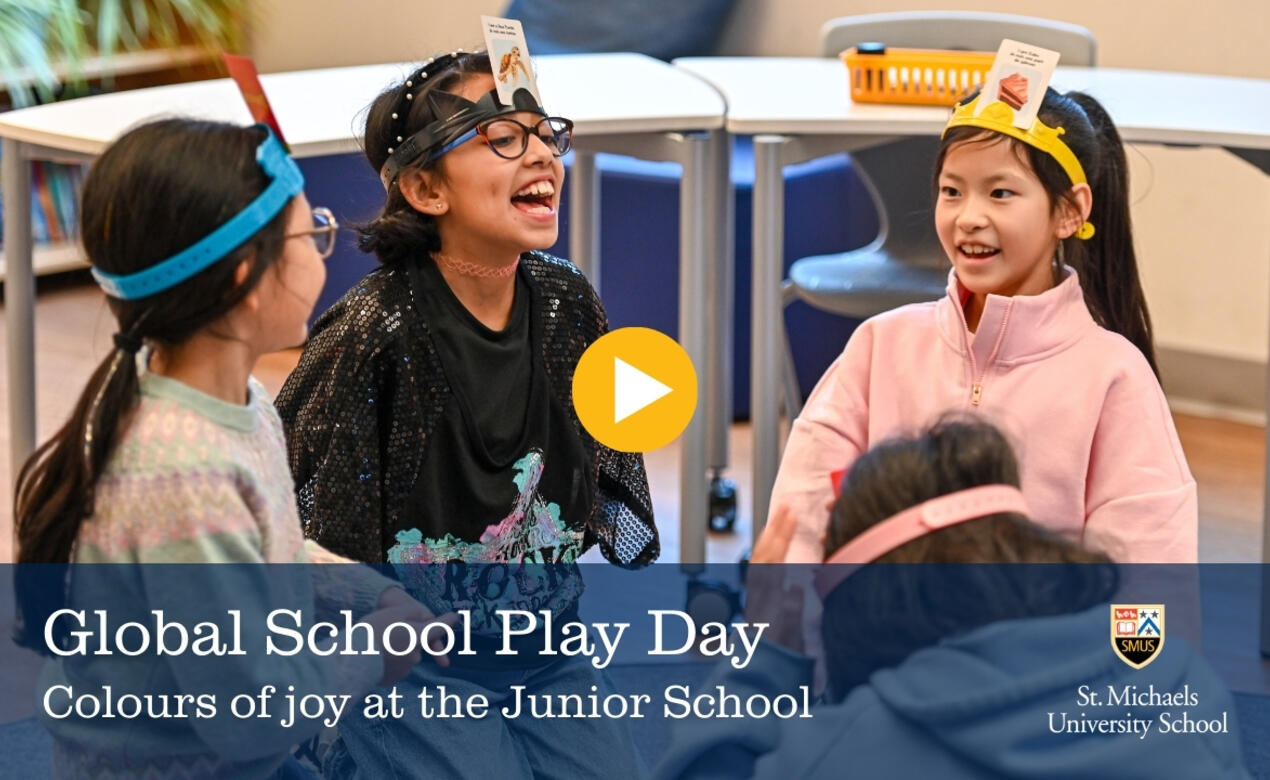
At St. Michaels University School, Junior School students were given the time and freedom to put that idea into practice. Affectionately known at SMUS as the Day of Joy, a recent afternoon invited students from Junior Kindergarten to Grade 5 to explore play in ways that felt meaningful to them, often resulting in moments of joy, connection, and discovery.
The guidelines were simple: no electronic or digital devices, no regular class instruction, and no uniforms. Beyond that, teachers created a range of activity spaces, allowing students the freedom to choose how they spent the afternoon.
Across the Junior School, joy took many forms. Some students gravitated toward high-energy activities, dancing freely, singing karaoke, or heading outdoors for games, even in the rain. Other spaces offered a quieter pace, with opportunities for crafting, mindfulness, and rest. The range of options reflected an important idea at the heart of the day: that well-being looks different for different children, and that having choice allows students to tune in to what they need.
“There’s no one walking around bored,” said Grade 5 teacher Mr. Keil. “Everyone’s finding something, and they’re really engaged.”
Teachers also noticed connections forming across age groups. Older and younger students naturally worked and played alongside one another, whether solving puzzles, sharing games, or simply spending time together. These moments highlighted how unstructured play can open space for collaboration and belonging across ages.
Student choice extended beyond movement and energy level to focus and interest. In the library, some students welcomed uninterrupted time to read, while others balanced quieter activities alongside livelier ones nearby. One student explained that he was able to concentrate amid surrounding noise because he knew how to tune it out, a reminder that engagement and focus can take many forms.
“Today is special because you get to choose what you do,” said Zoe, a student who spent part of the afternoon reading in the library with her friend Olivia. “Right now we’re getting caught up on reading club. Earlier we made spiders, and after this we’re going to yoga.”
For educators, the Day of Joy offered a clear contrast to the rhythms of a typical school day. Kindergarten teacher Katie McNeil noted that while play is already woven into daily learning, the extended, uninterrupted time made a difference. Without the need to stop and transition between classes, students were able to remain immersed in activities, following their interests at their own pace and allowing imagination to deepen. Older students, she added, also felt free to revisit early forms of play, reinforcing the idea that play remains valuable at every age.
By opening the Junior School campus to choice, creativity, movement, and rest, the Day of Joy offered more than a pause from routine. It created space for students to take ownership of their experience, supporting well-being while deepening the skills that underpin learning itself. In keeping with Global School Play Day’s focus on unstructured, child-led play, the afternoon served as a reminder that when children are given time and trust, play becomes a powerful foundation for growth.

Day of Joy at SMUS Junior School for Global School Play Day

Day of Joy at SMUS Junior School for Global School Play Day

Day of Joy at SMUS Junior School for Global School Play Day

Day of Joy at SMUS Junior School for Global School Play Day

Day of Joy at SMUS Junior School for Global School Play Day

Day of Joy at SMUS Junior School for Global School Play Day

Day of Joy at SMUS Junior School for Global School Play Day

Day of Joy at SMUS Junior School for Global School Play Day

Day of Joy at SMUS Junior School for Global School Play Day

Day of Joy at SMUS Junior School for Global School Play Day

Day of Joy at SMUS Junior School for Global School Play Day

Day of Joy at SMUS Junior School for Global School Play Day

Day of Joy at SMUS Junior School for Global School Play Day


