
What makes a ceremony different from other gatherings?
That’s the question that all three school divisions contemplated over the last two weeks. We noted the presence of (1) a specific purpose, (2) ritual elements, (3) a transition, and (4) the audience as witnesses.
Most of our students can readily confirm this through having attended a wedding with (1) a clear statement of purpose on the invitation, (2) an exchange of rings, (3) a transition from being single to being married, and (4) friends and family gathered as witnesses.
It’s the fourth aspect that I find most intriguing. We don’t go to a wedding to be entertained, as if we were sitting on a sofa in front of a screen or somewhere in the bleachers at a ball game. We don’t go as critics, ready to say that the wedding was a drag because the vows were boring. Rather, we go as witnesses to an important moment, something that speaks to deeper connections and higher values.
It’s the same, I suggest, when we prepare for our National Day for Truth and Reconciliation (NDTR) Ceremony. There’s a clear purpose in acknowledging the state of broader society’s relationship with Indigenous Peoples, and in our commitment to not impose our values in such a way to any other people. The “any other people” language holds great weight for our Elders. It’s not only about protecting themselves, but other groups as well. We follow rituals that use stories, songs, and words to both inform us and release us from holding on to guilt or sadness - our Elders would say “to surround and protect”. We also note the transition to which we’re called, moving from looking at the past to looking towards a world where we relate “in a good way.”
We are consistently reminded by our Elders that if we only ever look back, we will trip as we move forward. And, of course, the fourth element, where we move from simply viewing a gathering to witnessing a moment of deep significance, something that speaks to the way we will actively choose to live together.
This week we held ceremonies for NDTR at both the Junior School campus and the Richmond Campus for the Middle and Senior Schools. Addie Lee (Anishinaabe, Grade 2) offered welcoming words, including some about her culture. Everly Russel (Stó:lō and Seabird Island, Grade 6) asked Lynn Porteous (Grade 2 teacher) to help her tell the story of a grandmother explaining the importance of Indigenous culture to her grandchild.
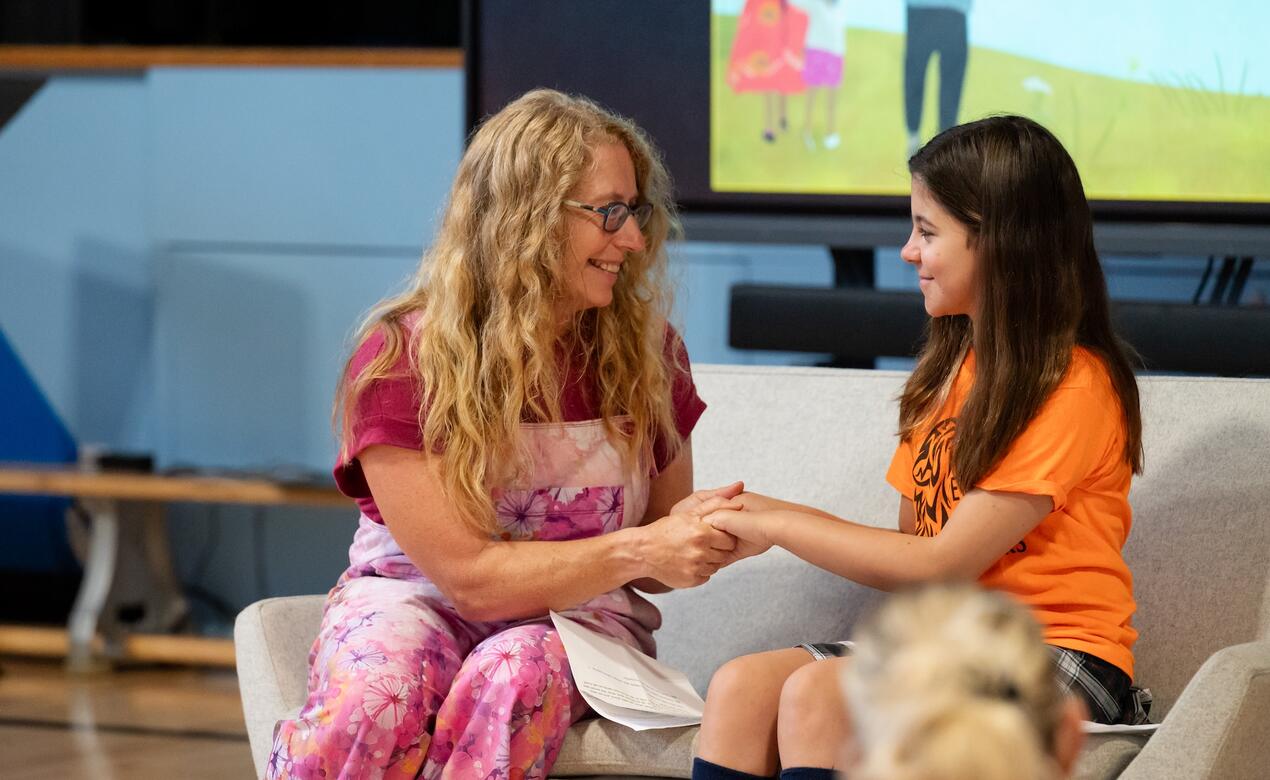
Abi Porttris (Red River Métis, Grade 10) shared words from the late Chief Dan George. Addy Newman-Ting (Kwakwak’wakw and Coast Salish, Grade 11) and Matthew Nacey (Animakee Wa Zhing, Grade 11) gave voice to a prayer written by our Titumels/Teacher, Bill White. Members of our Senior Choir sang a song gifted to us by Willie Pierre. Students from our grade five class contributed pieces of art for the background slides.
All of this came into being through the guidance of our Elders. Bill White (Snuneymuxw) shared how his mother embraced traditional teachings about love despite being sent to a residential school. Dr. Kim Recalma-Clutesi (Qualicum) had students hold up two masks at Junior School, and told a story about treating animals - and people - with respect. Willie Pierre (Katzie) opened each gathering with song, accompanied by his nephew, Francis Pierre (Katzie and Tsartlip). Following the Middle/Senior Ceremony, Dr. Ken Coates spoke about allyship ultimately connecting to relationship. Also in attendance for the Middle/Senior School ceremony were Elder Jo-Ina Young (Métis), and Carey Newman (Kwakwak’wakw and Coast Salish).
All this, with a clear purpose to acknowledge what has happened, and commit ourselves to a more respectful path. All this, witnessed by the span of our community, young and old.