

When several former St. Michaels University School students were asked to reflect on a digital detox experiment they completed as Grade 8 students ten years ago, one answer stood out. Looking back on her years at SMUS, one said her favourite memories had nothing to do with her phone.
Current Middle School students heard those reflections during an assembly this month, where Middle School Humanities teacher Tanya Lee revisited the experiment through a presentation that included video clips from the original project and new reflections recorded by some of the students who took part a decade ago. The assembly was part of the Middle School’s focus on well-being this March.
For the students in the audience, the presentation offered a chance to think about how technology fits into their own daily routines and how moments of boredom, distraction or connection shape their time with friends and family.
Back in 2016, smartphones and social media were only just becoming a growing part of daily life, and educators were beginning to explore how constant connectivity might shape students’ attention and daily routines. At SMUS, that exploration took shape in a Grade 8 communication skills class led by Lee, who invited students to step back from their devices and consider how technology was influencing the way they spent their time.
Students agreed to place their phones in a lockbox for the weekend. For some, the experience felt uncomfortable at first. A few wrote down friends’ landline numbers before handing their devices over so they could still make plans. One student lasted only until recess before asking for his phone back.
But for many others, the weekend created space for something different.
Students spoke about playing board games with family members, spending time outdoors and reconnecting with friends in ways that felt more present and less distracted. When the class regrouped the following Monday, they shared what the experience had been like and discussed how their relationship with technology might change moving forward.
After the weekend, students created their own guidelines for healthier technology habits. Some were simple: no phones at meals, choosing conversation over scrolling and remembering to take a picture of the moment, not create a moment for the picture.
A decade later, several of those former students reflected on the experience and what they learned from it. One said the challenge helped them realize how much time opens up when they step away from their screens. Another encouraged today’s Middle School students to notice how often they reach for a device, particularly in moments of boredom or stress. One former student, now in university, said that when she looks back on her years at SMUS, her favourite memories have nothing to do with her phone.
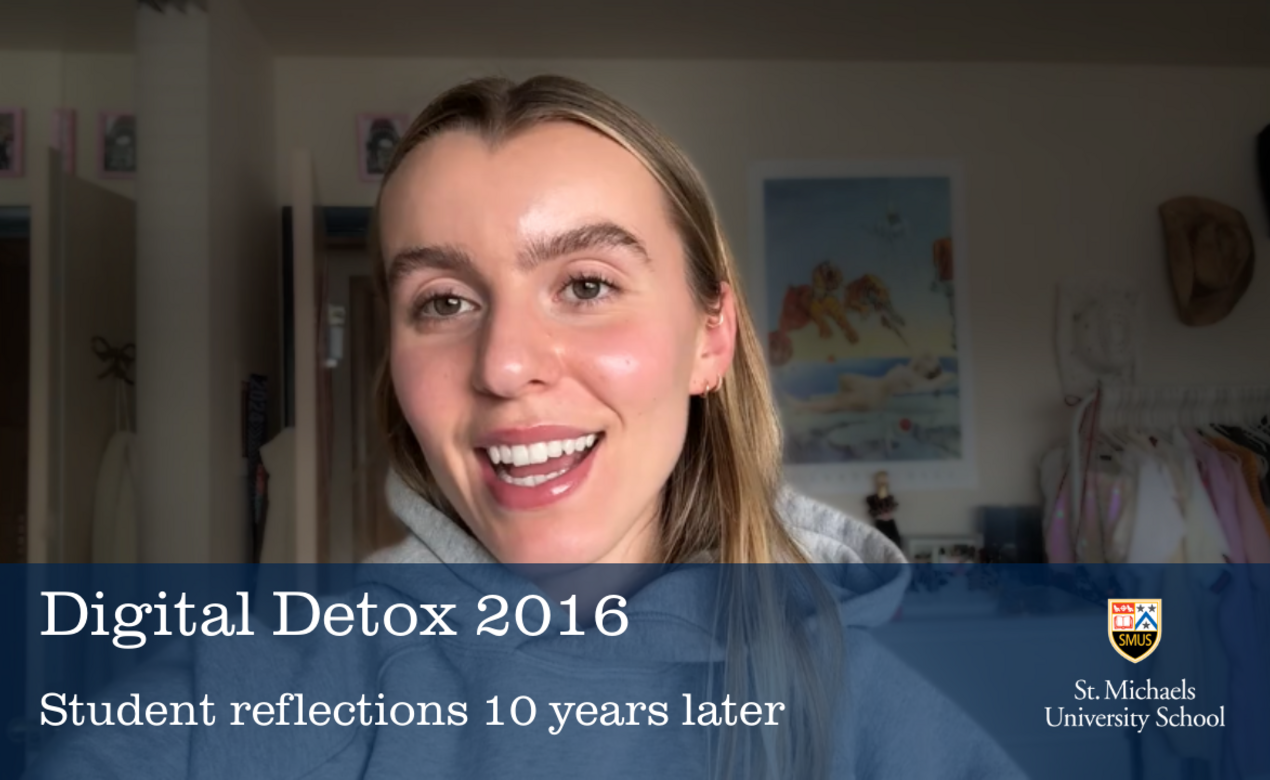
Former SMUS students Callum Colgate, Julia McDermott and Claire Pontefract reflect on participating in a digital detox experiment as Grade 8 students a decade ago.
For Lee, those reflections reinforce an important message for today’s students. In a world where technology is always within reach, developing balanced habits around its use has become an important part of student well-being. At SMUS, students are encouraged to establish healthy routines around the use of technology.
For the month ahead, Lee encouraged students to pause before reaching for a device and ask themselves why. Is it purposeful, or simply habit? If it is habit, she suggested trying something different: talk to a friend, spend time with family, step outside, or sit quietly for a moment.
“Lean into being bored,” she said. “That’s where the magic happens.”
Sometimes, the most meaningful moments are the ones that unfold when we put our screens aside and simply look up.


