
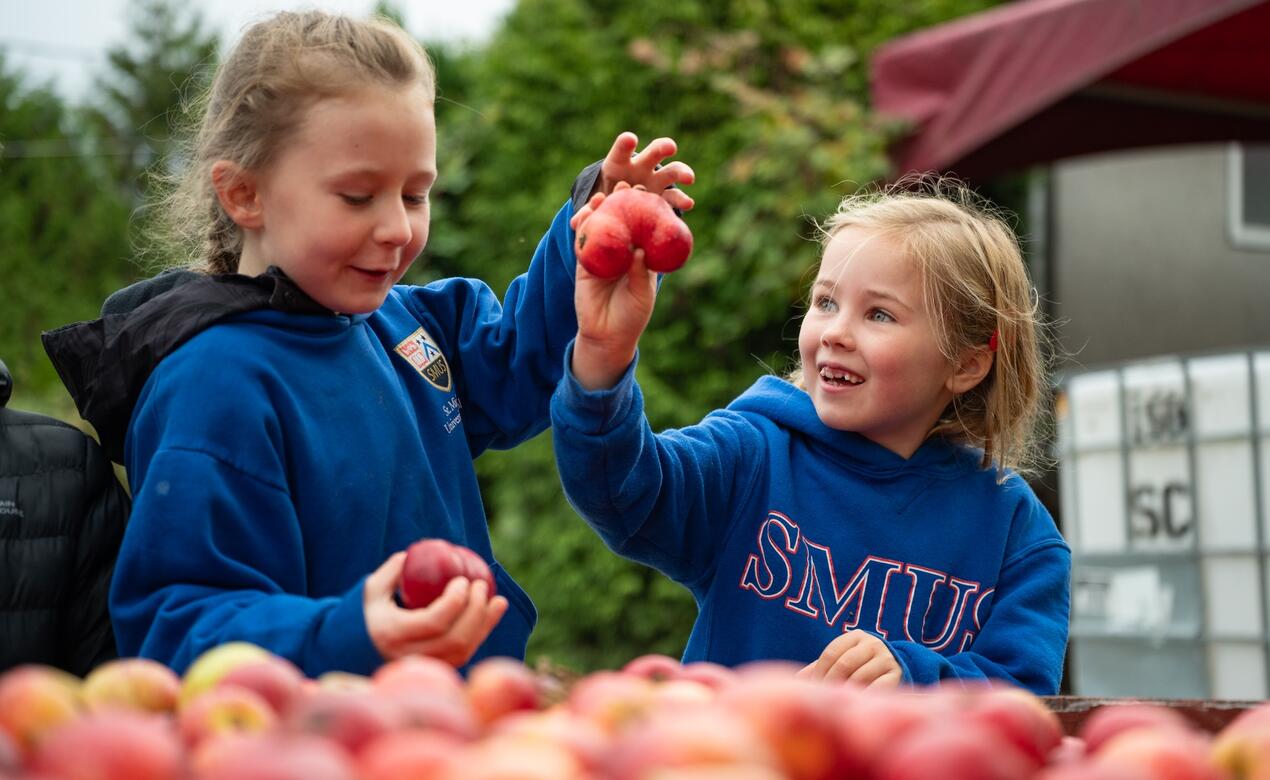
“So red. So sparkly. So round!”
For St. Michaels University School Grade 2 student Addie, an apple picked at Sea Cider Farm & Ciderhouse offered plenty to observe. Its colour, shape and shine were among the details students in Lynn Porteous’s and Michelle Janke’s classes explored during their Oct. 13 visit to the Saanichton farm, where a familiar fruit became the starting point for scientific discovery.
“As we launch into our science unit on matter, this visit to Sea Cider Farm was a perfect starting point to engage all our senses and make observations to describe properties of matter,” said Brooke Kray, Grade 2 associate teacher. “The process of turning apples to cider touches on all three states of matter: solids (apples), liquids (juice) and gases (carbonation). We were also able to observe many properties of matter, such as colour, taste, odour, shape, size, buoyancy, texture, temperature, weight, opacity and transparency.”
From collecting apples in the orchard to watching the press extract juice and tasting non-alcoholic sparkling ciders, students used their senses to investigate the properties of matter and follow apples from tree to glass.
Looking Closely in the Orchard
The visit began with a question: What kinds of apples could the students name?
Granny Smith, Pink Lady, Ambrosia and Honeycrisp were among the answers. One student offered another category: “Rotten apple.”
Their guide, Molly, introduced them to a different collection. Sea Cider grows varieties such as Kingston Black, Northern Spy, Dabinett and Porter’s Perfection. These heirloom apples, she explained, have histories stretching back hundreds of years.
Invited to collect apples left behind after harvesting, students headed down the orchard rows. With solid matter now in their hands, they considered its properties. How heavy was an apple? What colour was it? Did it smell? Was it hard or soft?
Bruises, blemishes and holes prompted discussion about the insects, worms and birds that might leave their marks. Students also explored what organic farming means, offering ideas about caring for the land and avoiding extra chemicals.
They drew their apples on worksheets, recording what they noticed. There was room for imagination, too. When asked whether they would live in an apple if they were a worm, one student had a practical answer.
“Yes. They’re very juicy, plus you could eat your home!”
From Apple to Sparkling Juice
“This is one of our favourite field trips because we get to see firsthand a working farm in action and observe the entire process of making cider, from picking the apples off the tree to tasting the finished product,” Kray said.
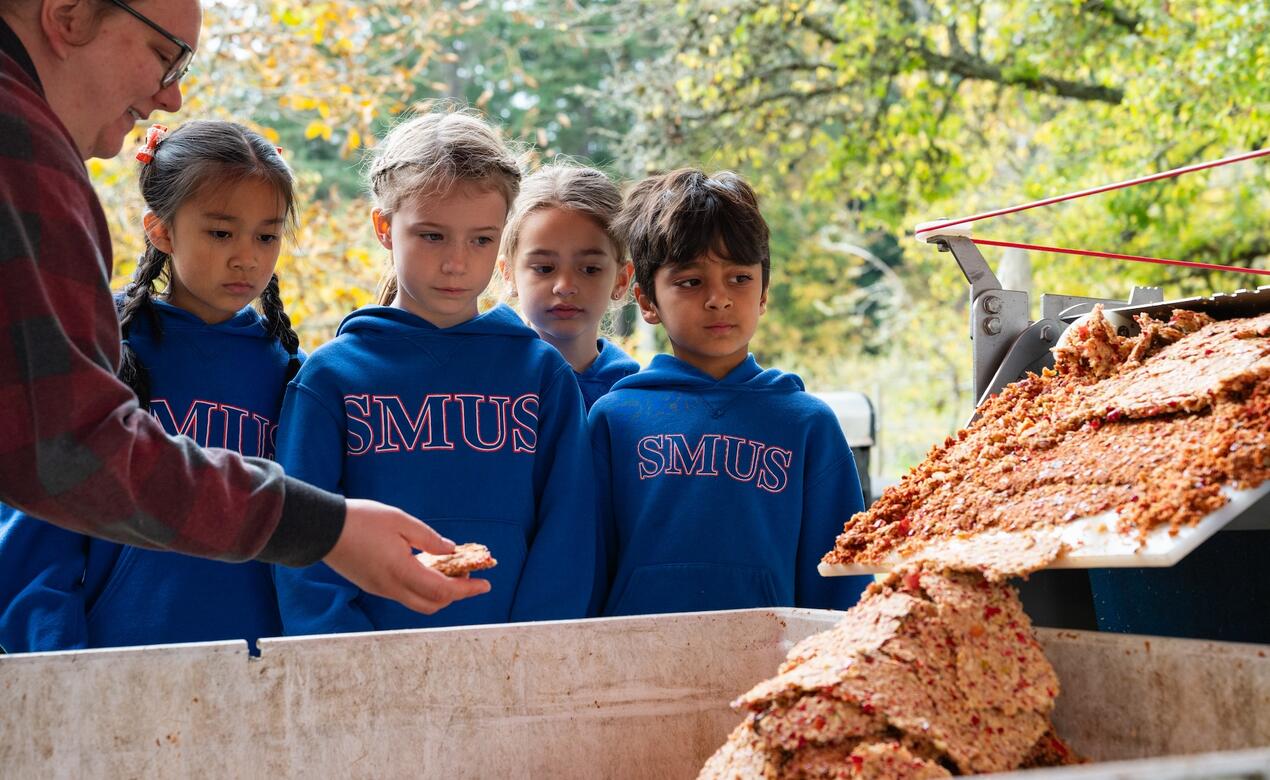
In small groups, students watched machinery press the apples and extract their juice.
“There’s a mini elevator!” one observed.
Listening was part of the investigation. Asked to record what they could hear, students identified the machine, the wind and people talking.
Molly then asked how the cider might get from a large bin into a glass. Students offered explanations about squeezing apples, collecting juice and filling bottles. They also recognized another step.
“You’ll have to get a machine that will turn it fizzy!” said Quintin.
Molly explained that the juice is carbonated before it is bottled.
Inside, the investigation continued with three non-alcoholic sparkling ciders featuring apple blossom, apricot and elderflower, or raspberry. Before sipping, students were encouraged to notice each drink’s smell, colour and thickness.
Their descriptions ranged from “honey” to “sour and sweet.” When asked how the bubbles felt in their mouths, they offered words including “bumpy,” “smooth” and “tickly.”
Joy and discovery were woven throughout the morning, from laughter over a “three-headed apple” to delighted announcements about tickly bubbles. With their senses on high alert, students were thinking like scientists: observing closely, asking questions and making connections.
Those discoveries will carry into apple-related classroom experiments exploring physical and chemical changes in matter, building on a day that showed how learning and joy can grow together.