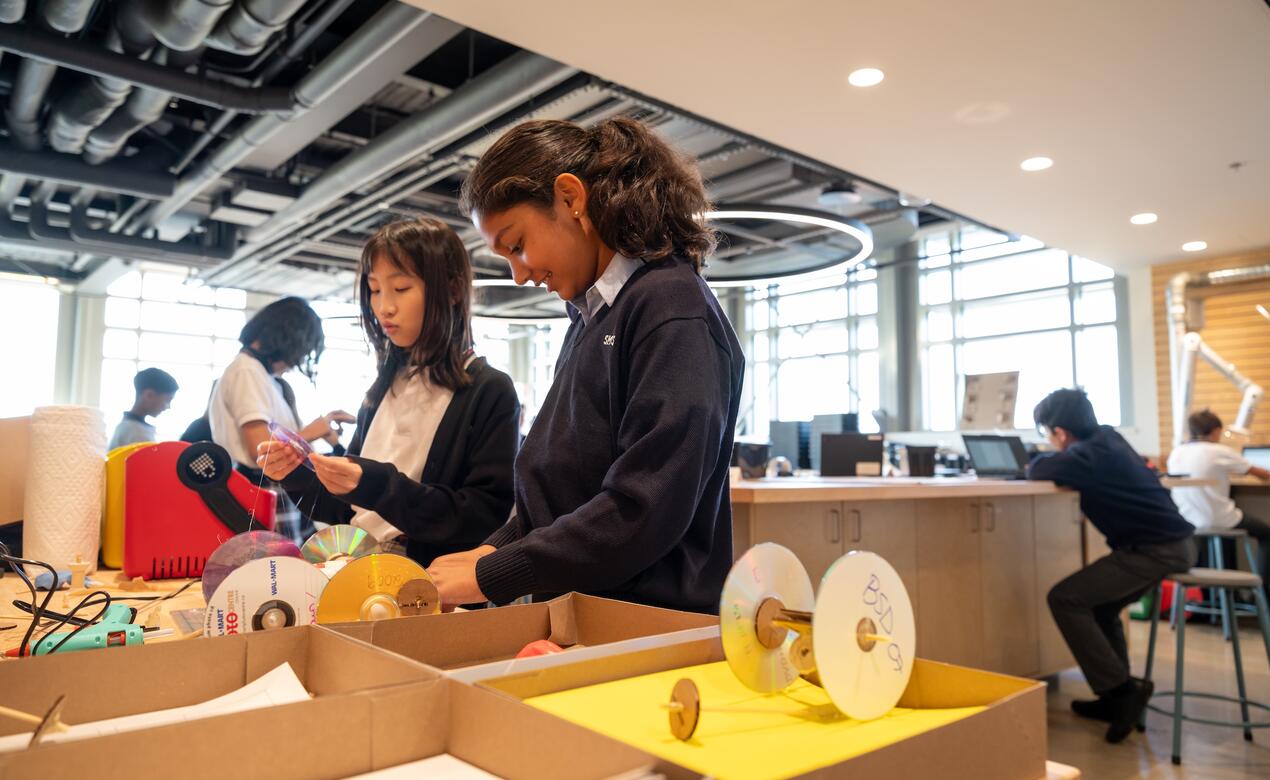
Cardboard, CDs, sketches and prototypes are taking shape as race cars on the third floor of the new Considine Annex at St. Michaels University School.
The annual Grade 6 Race Car Challenge is a hallmark of the Middle School experience. This year, a bright, purpose-built engineering and design space is bringing fresh energy to an established approach to hands-on learning.
For teacher George Floyd, it is a place to explore “the messiness of invention.” For Grade 6 student Devon, the appeal is having a say in the work.
“In other classes, we’re given work to do. Here, we can decide what work we do,” said Devon. “It’s more fun.”
That ownership is central to Applied Design, Skills and Technologies (ADST). Every Middle School student takes the subject, learning to research, plan, design, build and improve ideas while developing practical and digital skills.
From an Idea to a Working Car
Design teachers George Floyd and Lindsey Ashton work alongside Grade 6 mathematics and science teachers to connect learning about Newton’s laws of motion with a practical challenge: build a car that travels quickly and far.
Students develop two- and three-dimensional design skills while investigating how materials, friction, weight and wheel alignment affect performance.
“We intentionally step back a little because we want this to be an authentic experience for them,” said Floyd. “We could easily give them a template and say, ‘Here’s a kit, build the kit.’”
Instead, students choose an approach, test their assumptions and decide what needs to change.
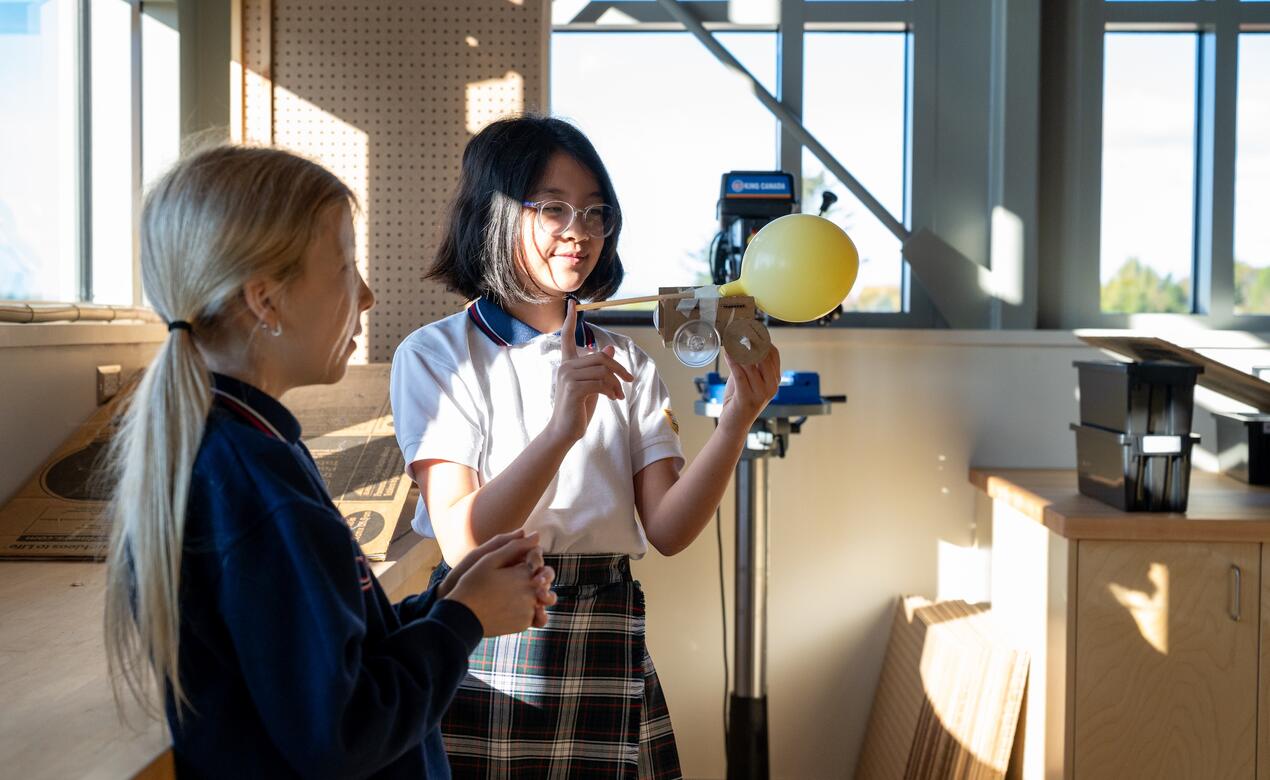
Oliver and his partner are taking inspiration from Formula 1 cars, exploring a pointed front and sloping body to make their vehicle more aerodynamic.
Ben and Kingston have built early prototypes using cardboard, CDs, tape and hot glue. Ben has already identified an adjustment: the holes in his wheels need to be smaller. Neither expects the next version to be perfect.
“Every time you make a mistake, you always gotta just try, try again and work through it,” said Kingston.
For Devon, Zara and Olivia, choosing CD wheels meant widening their car so the wheels could turn without colliding. Having taped their prototype together, they are considering 3D-printed connectors for the next version.
Each group faces the same challenge, but the designs and decisions belong to the students.
A Foundation for What Comes Next
In the new ADST space, students move between digital plans, hands-on construction and conversations about what to try next. Alongside technical skills, they are practising how to explain ideas, consider alternatives and make decisions together.
That emphasis reflects conversations with educators beyond SMUS. Floyd recalled a University of Victoria engineering professor highlighting the need for talented engineers who could also communicate and collaborate effectively.
“It’s learning to work in teams,” said Floyd. “That’s one of the most critical takeaways of the project actually.”
Middle School ADST builds on exploration in the Junior School’s Imagination Lab and early design classes, while preparing students for more complex engineering and design opportunities in Senior School. Students joining SMUS in Grade 6 build those foundations alongside their classmates.
Race day in early November will test their cars. The process is already developing the practical skills, flexibility and cooperation students will carry into future classrooms, workplaces and projects.